

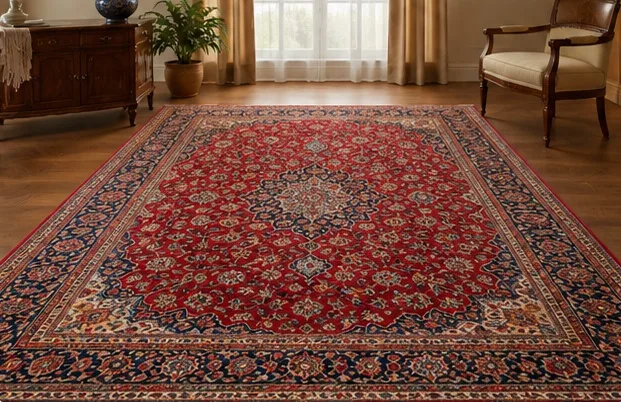
Kashan has a long history of carpet making, and its name is still associated with some of the best-known designs in Persian rugs. Floral patterns, central medallions and rich colors are common features, but Kashan rugs aren’t all alike. Their materials, construction and quality can differ significantly.
If you’re considering buying a Kashan rug, knowing a little about its design and weaving tradition can help you compare pieces more confidently. This guide covers the main characteristics of Kashan rugs, how to assess their quality, what affects their price and where to find them in Iran.
Quick Answer: What Is a Kashan Rug?
A Kashan rug is a Persian rug associated with Kashan, a historic city in central Iran. Many feature floral designs, central medallions and decorative borders, often in colors such as red, blue and ivory. They may be made from wool or other materials, with silk used in some examples. Their price depends on factors such as size, materials, craftsmanship, condition and provenance.
SEO Title:
Meta Description: Explore Kashan rugs, from their traditional floral designs and rich colors to materials, quality and prices. Find out what to look for when buying one.
URL: /blog/iran/kashan-rugs/
Primary keyword: Kashan rugs
Secondary keywords: Kashan rug, Kashan Persian rug, Persian Kashan rugs, Kashan carpets, handmade Kashan rug, authentic Kashan rug, Kashan rug price, Kashan rug designs, buy Kashan rug, Kashan carpet Iran
Search intent: Informational and commercial investigation
Suggested schema: Article + FAQ
Breadcrumb: Home → Blog → Iran → Kashan Rugs
What Makes Kashan Rugs Special?
Kashan is one of the best-known names in Persian carpet making. Located in central Iran, the city has a long history of producing fine textiles and carpets, including luxurious silk pieces that date back to the Safavid period.
Kashan rugs are often associated with floral patterns, central medallions, detailed borders and rich colors. Deep red, navy blue and ivory appear in many traditional designs, although the range is much wider than that.
Part of the appeal is the balance between the different elements. A central medallion may draw the eye, while flowers and curved lines fill the surrounding space. The border frames the design and gives the rug a finished appearance.
Of course, not every Kashan rug looks alike. Some are finely woven and highly detailed; others are simpler. Materials, age, condition and craftsmanship also vary.
If you’re considering buying one, it’s worth learning a little about the style before comparing individual rugs. Our guide to buying Persian rugs in Iran explains how to assess a rug and what to ask a seller.
A Brief History of Kashan Carpets
Kashan’s reputation for fine textiles goes back centuries. During the Safavid period, the city became associated with luxury textile production, including silk carpets made for wealthy patrons.
Some historic carpets attributed to Kashan survive in museum collections today. These include silk examples that show the level of detail and craftsmanship associated with the city’s weaving tradition.
Kashan’s importance in Persian carpet history is not limited to these exceptional pieces. The city’s name remains closely connected with traditional carpet designs and handmade weaving.
That history is useful context when you’re shopping, but it doesn’t tell you everything about a modern rug. A newly made Kashan rug and a centuries-old carpet are very different objects, even if both are associated with the same tradition.
For a contemporary purchase, focus on the individual rug’s construction, materials, condition and documented origin.
How to Recognize a Kashan Rug
Many Kashan rugs have a formal design built around a central medallion. The field surrounding it is often filled with flowers, leaves, vines and other traditional motifs.
A decorative border usually frames the main design. In a well-balanced composition, the border complements the central field without drawing attention away from it.
Colors can range from rich reds and dark blues to softer shades of ivory and beige. Some designs have strong contrast, while others use a more restrained palette.
These characteristics can help you recognize the style, but they aren’t proof of origin. Other Persian rugs share similar design elements, and modern rugs can borrow traditional patterns.
If a seller identifies a rug as Kashan, ask what supports that attribution. The design is one clue, but construction and information about the rug’s origin also matter.
What Materials Are Used in Kashan Rugs?
Kashan rugs are made with different materials, depending on the rug’s age, style and quality.
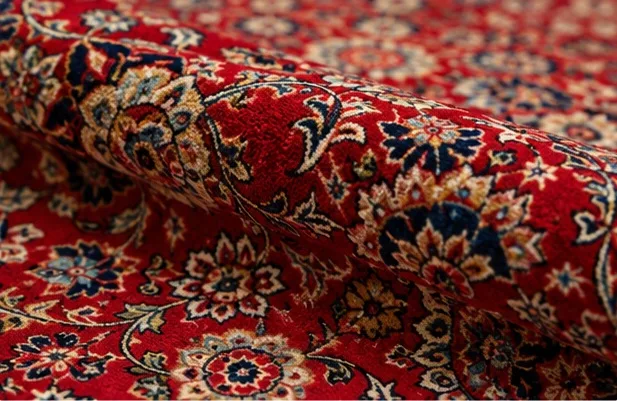
Wool is commonly used for the pile of handmade Persian rugs. Its quality affects the feel and appearance of the finished carpet.
Cotton is often used in the foundation, which provides the structure for the knots.
Silk has a particularly important place in Kashan’s history of luxury carpet making. Some historic Kashan carpets were made from silk, but this doesn’t mean that every rug sold as Kashan is a silk rug.
If you’re considering a modern rug, ask the seller which materials were used in the pile and foundation. If the rug is described as a silk or silk-blend piece, clarify exactly where the silk appears.
Material alone doesn’t determine quality. A rug made with good wool and careful workmanship may be a better choice for your home than a poorly made piece containing silk.
Common Kashan Rug Designs
Central Medallions
The central medallion is a familiar feature of many traditional Kashan rugs. It provides a focal point, with smaller motifs and floral patterns arranged around it.
Medallions vary in size and shape, so you won’t find the same composition on every rug.
Floral Patterns
Flowers, leaves and curving vines are common throughout Kashan designs. They may fill the central field or appear in smaller groups around the medallion.
The level of detail depends on the individual rug and the weaver’s design.
Traditional Borders
The border frames the main design and often contains its own repeating motifs.
When examining a rug, look at how the border relates to the central field. The two should work together as a composition.
Color and Contrast
Rich reds, dark blues and ivory are often associated with traditional Kashan rugs. These colors can give a room a warm, formal look.
However, color is not a reliable way to establish a rug’s origin. Similar palettes appear in other Persian carpet styles, and modern interpretations can differ from older designs.
How to Check the Quality of a Kashan Rug
A rug’s regional name is only part of the story. Two carpets both sold as Kashan rugs may differ considerably in workmanship, materials and condition.
Here’s what to examine before making a decision.
Check the back
Turn the rug over and look at the knots.
A hand-knotted rug normally shows individual knots on the reverse, with the design visible from the back as well. This can help you understand how the rug was made, although it doesn’t prove its exact origin.
If you’re new to handmade carpets, our guide to identifying an authentic Persian rug explains what to look for.
Look at the details
Examine the medallion, flowers and border. Are the patterns clearly defined? Do the different elements work together?
Fine weaving can allow for intricate detail, but a high knot count by itself doesn’t guarantee a better rug. The quality of the materials and the execution of the design also matter.
Ask about the materials
Find out what the pile and foundation are made from. If the seller describes the rug as silk, ask for clarification about how much silk it contains and where it is used.
For an expensive purchase, don’t rely solely on a verbal description.
Inspect the condition
Look for worn patches, holes, stains, fading and signs of repair. Check the edges and fringe as well.
An older rug may have some wear or repairs without losing its appeal. What matters is understanding its condition and making sure the asking price reflects it.
Check the shape
If possible, lay the rug flat and look at its overall shape. Notice whether the edges and corners sit properly.
Small irregularities can occur in handmade rugs. Significant distortion, however, may affect the appearance and how easily the rug fits into your room.
How Much Does a Kashan Rug Cost?
Kashan rugs don’t have a fixed price range. A small, relatively simple handmade rug and a finely woven piece with documented history can differ enormously in value.
The price usually depends on several factors:
- Size: Larger rugs generally require more material and more work.
- Materials: Wool quality and the use of silk can affect the price.
- Craftsmanship: The quality of the weaving and the detail in the design matter.
- Condition: Wear, damage and repairs can reduce a rug’s value.
- Age: An older rug isn’t automatically more valuable. Its condition, quality and history also matter.
- Provenance: Reliable documentation can be important for historic or unusually expensive pieces.
If you’re looking at a rug described as antique or rare, ask what evidence supports that claim. Age and origin can be difficult to establish from appearance alone.
For a broader explanation of pricing, including the differences between various types of Persian rugs, read How Much Does a Persian Rug Cost?.
The most useful comparison is between rugs of similar size, materials, construction and condition—not simply between two pieces carrying the Kashan name.
Kashan Rugs vs. Nain Rugs
Kashan and Nain rugs can both feature intricate floral designs and central medallions, but many have a different overall appearance.
Kashan rugs are often associated with richer reds, blues and traditional medallion compositions. Nain rugs, by contrast, are frequently recognized for lighter backgrounds, particularly ivory and cream, with blue details.
These are general characteristics rather than strict rules. Both traditions include variations in design, color and quality.
If you’re drawn to lighter interiors and delicate patterns, it may be worth comparing a few Nain rugs with Kashan examples before deciding.
Our guide to Nain rugs explores their designs, materials and construction in more detail.
Kashan Rugs vs. Tabriz Rugs
Tabriz is another major center in Iran’s carpet-making tradition, and its rugs cover a broad range of designs.
Kashan rugs are often associated with floral compositions and central medallions. Tabriz rugs can also feature these elements, alongside other intricate designs and patterns.
There is considerable overlap, so it isn’t always possible to distinguish a rug’s origin from its design alone.
Rather than deciding based on the name, compare the actual rugs. Look at the materials, weaving, condition and price, and ask the seller about the origin.
You can learn more about the different designs and qualities of Tabriz rugs in our separate guide.
Where Can You Buy Kashan Rugs in Iran?
If you’re visiting Iran specifically to explore Kashan rugs, going to Kashan itself is a natural starting point. You can also find rugs associated with the city in carpet shops and larger markets in Tehran, Isfahan and other urban centers.
Visiting Kashan offers something beyond shopping. The city is known for its traditional houses, historic architecture and craft traditions, making it an interesting stop for travelers exploring central Iran.
If you want to include local markets and cultural sites in your itinerary, browse tours in Kashan or connect with local tour guides in Kashan.
A local guide may help you navigate the city, communicate with sellers and plan your visits. If you’re buying an expensive rug, however, you should still assess its quality independently and seek professional advice when necessary.
What to Ask Before Buying a Kashan Rug
When you find a rug you like, take a little time to ask about it before negotiating the price.
Useful questions include:
- Where was the rug made?
- Is it hand-knotted?
- What materials were used?
- Is the pile wool, silk or a combination?
- What are the exact dimensions?
- Is its age known?
- Has it been repaired?
- Can the seller explain its design or origin?
- Is there any documentation available?
The answers can help you compare it with other rugs and understand what you’re paying for.
For an expensive piece, especially one described as antique, rare or particularly valuable, consider getting an independent assessment. A seller’s description is useful, but it shouldn’t be the only basis for a major purchase.
Are Kashan Rugs Suitable for Modern Homes?
Although Kashan rugs are associated with traditional Persian designs, they aren’t limited to traditional interiors.
A rug with a central medallion can work well in a living room or dining room, where it creates a clear focal point. A more restrained color scheme may suit a modern space, while a rug with deep red and blue tones can add contrast to a neutral room.
Before buying, measure the area where you plan to use the rug. Think about how it will sit beneath your furniture and whether its colors work with the rest of the room.
It’s also worth considering foot traffic and maintenance. Ask about the materials and the care the rug requires, especially if you plan to put it in a frequently used area.
The best choice is not necessarily the most expensive or finely woven rug. It’s the one that suits your space, preferences and budget while offering the quality you expect.
Kashan Rug Buying Checklist
Before you buy, make sure you’ve checked:
The construction and knots on the back
The pile and foundation materials
The quality of the pattern and weaving
The edges, corners and fringe
Any stains, worn areas or repairs
The exact dimensions
The seller’s information about the rug’s origin
The asking price compared with similar rugs
Frequently Asked Questions About Kashan Rugs
What are Kashan rugs known for?
Kashan rugs are often associated with floral designs, central medallions, decorative borders and a long tradition of Persian carpet making. Their colors and construction vary depending on the individual rug.
Are Kashan rugs Persian rugs?
Yes. Kashan rugs are associated with Kashan, a city in central Iran, and form part of the broader Persian carpet tradition.
Are Kashan rugs made of silk?
Some are, but not all. Silk has an important place in Kashan’s history of luxury carpet production, while many other rugs associated with the region use wool and cotton. Always ask about the materials of the specific rug you’re considering.
Are Kashan rugs expensive?
Prices vary widely. Size, materials, workmanship, condition, age and provenance all affect the price. Some rugs are relatively affordable, while fine or historically important examples can be much more expensive.
Are Kashan rugs handmade?
Many traditional Kashan rugs are handmade, but you shouldn’t assume that every rug sold under this name is hand-knotted. Check the construction and ask the seller for details.
How can I tell if a Kashan rug is authentic?
Examine the back, knots, materials and overall construction. Ask about its origin and look for supporting documentation when appropriate. For an expensive purchase, consider an independent assessment.
Final Thoughts
Kashan has a long and important place in Persian carpet history, and its rugs come in a wide range of designs and qualities. Some appeal because of their rich colors and floral patterns; others stand out for their fine weaving or historical significance.
If you’re planning to buy one, take your time comparing individual rugs. Look beyond the name, ask about the materials and condition, and make sure the price reflects what you’re actually getting.
And if you’re visiting Iran, consider exploring Kashan beyond its carpet shops. The city’s architecture, markets and traditional crafts make it worth a visit in its own right.
For more practical advice before your trip, start with our complete guide to buying Persian rugs in Iran.
Leave a Reply