

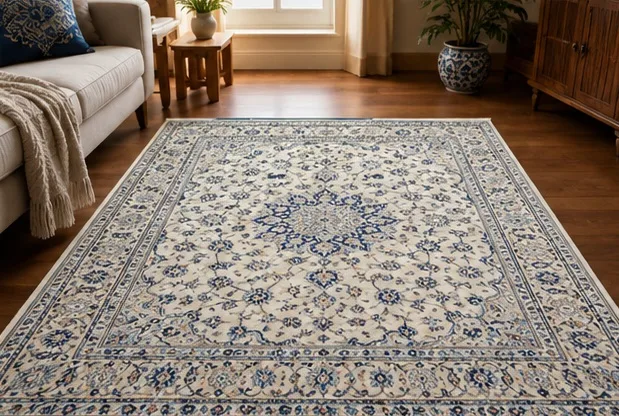
Nain rugs are easy to recognize for their delicate patterns and often light color palettes, but there’s more to them than ivory backgrounds and blue floral designs. Their materials, weaving quality and construction can vary considerably, which makes it worth knowing what to look for before buying one.
Whether you’re comparing Persian rugs online or planning to shop in Iran, this guide explains what distinguishes Nain rugs, how to assess their quality, what affects their price and where you can look for them.
Quick Answer: What Is a Nain Rug?
A Nain rug is a type of Persian rug associated with Nain, a city in central Iran. Many examples feature fine floral patterns, ivory or cream backgrounds and blue details. Traditional Nain rugs often have a wool pile and cotton foundation, while some finer pieces incorporate silk. Quality and price depend on the materials, weaving, design and condition of the individual rug.
What Makes Nain Rugs Special?
Nain rugs are known for their fine patterns, carefully balanced designs and relatively light colors. Many feature an ivory or cream background decorated with blue flowers, delicate vines and a central medallion. The result is a rug that can look detailed without making a room feel too busy.
These rugs take their name from Nain, a city in central Iran, not far from Isfahan. Although Nain has a long history of traditional crafts, its reputation for fine carpet weaving developed particularly during the 20th century.
Not every Nain rug looks the same, of course. Some have elaborate patterns and very fine weaving, while others are simpler. Materials, workmanship and condition can also differ considerably, even between rugs sold under the same name.
If you’re thinking of buying one, it helps to understand what you’re looking at before comparing prices. Our guide to buying Persian rugs in Iran covers the broader process, from checking quality to choosing a seller.
How to Recognize a Nain Rug
Color is often the first thing people notice.
Ivory, cream, beige and different shades of blue appear frequently in Nain rugs. Dark blue may be used for contrast, while small areas of brown, red or other colors add detail to the pattern.
The designs are usually intricate. You might see a central medallion surrounded by flowers, leaves and curling vines, with a decorative border framing the entire composition.
Many Nain rugs have a formal, symmetrical appearance. This is one reason they work well in traditional interiors, although their lighter colors can also suit more contemporary spaces.
Still, color and design alone cannot tell you whether a rug was made in Nain. Similar patterns appear in other Persian rugs, and sellers may use regional names in different ways. If the origin matters to you, ask the seller for details rather than relying on appearance alone.
What Are Nain Rugs Made Of?
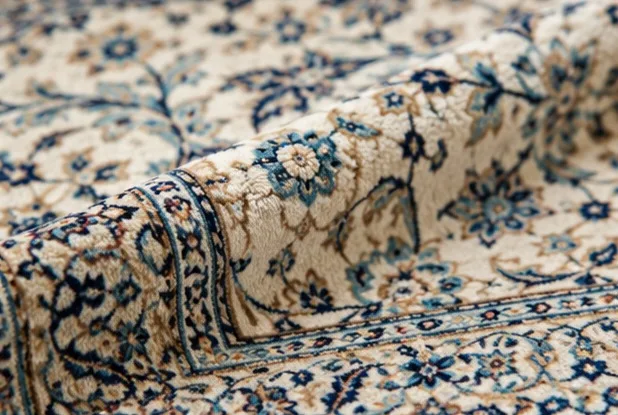
Many traditional Nain rugs have a wool pile and a cotton foundation. Some finer examples incorporate silk, either in parts of the design or more extensively.
Each material affects the rug’s appearance and feel.
Wool is commonly used for the pile. Its texture, quality and resilience influence how the rug feels underfoot and how well it wears.
Cotton is often used for the foundation, the structure that supports the knots and holds the rug together.
Silk can create fine details and a subtle sheen. Depending on how it is used, it may make parts of a design stand out more clearly.
A rug containing silk is not automatically better than one made from good-quality wool. The overall construction, materials and workmanship all matter.
If a seller describes a rug as silk or silk-blend, ask which parts are made from silk. This is more useful than relying on a general label.
Understanding Nain Rug Quality and the Term “La”
When shopping for Nain rugs, you may come across terms such as 9 La, 6 La or 4 La. These are used in the Nain rug trade to distinguish certain types of construction or grading.
The terminology can be confusing, especially for someone buying a rug for the first time. It is best not to treat a number as a universal quality rating or assume that every seller uses the terms in exactly the same way.
Instead, examine the rug itself.
Look at the back to see how clearly the knots are defined. Check whether the pattern is well executed and whether the pile, edges and corners are in good condition. Ask what the seller means by the grade they’re quoting, and whether they can explain how it relates to the rug in front of you.
A label can be a useful starting point, but it shouldn’t replace a close look at the actual piece.
How to Check the Quality of a Nain Rug
You don’t need to be a carpet expert to make a more informed comparison. A few practical checks can help you spot differences between rugs.
Look at the back
Turn the rug over and examine its construction. A hand-knotted rug normally shows individual knots, and the pattern should be recognizable on the reverse.
The back won’t tell you everything about a rug’s origin or value, but it can help you understand how it was made.
For a closer look at the signs of handmade construction, see our guide to identifying an authentic Persian rug.
Examine the pattern
Look at the details of the flowers, medallion and border. Are the shapes clearly defined? Does the design look balanced? Is the pattern consistent with the level of detail you would expect from the rug?
Handmade rugs can have small irregularities. These aren’t necessarily defects; what matters is the overall workmanship.
Check the pile and materials
Gently feel the pile and look for signs of wear. Wool quality varies, so softness alone isn’t a reliable measure of value.
If the rug has silk details, look at how they’re incorporated into the design. Ask the seller to confirm the materials rather than trying to identify every fibre by sight.
Inspect the edges and corners
Pay attention to the sides, corners and fringe. Loose sections, damaged edges and repairs can affect the rug’s condition and the price you should be willing to pay.
A repaired rug isn’t automatically a poor purchase. The important thing is to know about the repairs before buying.
Check for fading and damage
Look for worn patches, stains, holes and uneven fading. Some fading may be consistent with age, but significant damage should be taken into account when assessing the price.
If you’re considering an expensive rug, a professional assessment may be worthwhile.
How Much Does a Nain Rug Cost?
There isn’t one standard price for a Nain rug. A small, relatively simple piece and a large, finely woven rug with silk details can be very different purchases.
The main factors affecting price include:
- Size: Larger rugs generally require more material and more weaving time.
- Materials: The quality of the wool and the use of silk can affect the price.
- Weaving and detail: Fine, carefully executed patterns may require considerable skill.
- Condition: Wear, repairs and damage can influence value.
- Age and provenance: Older rugs with a well-documented history may attract different prices from newer examples.
- Seller and market: Prices can vary between shops and countries.
Don’t assume that a rug is fairly priced simply because it’s described as a Nain. Compare similar pieces, ask about the materials and condition, and find out what justifies the asking price.
For a broader overview of the factors that affect prices, read [How Much Does a Persian Rug Cost?].
Nain Rugs Compared With Other Persian Rugs
If you’re choosing between different Persian rugs, it helps to compare their overall appearance and construction rather than relying only on regional names.
Nain vs. Tabriz Rugs
Nain rugs are often associated with light backgrounds, blue details and fine floral patterns. Tabriz rugs come in a wider range of designs and color combinations, including medallion, floral and other intricate patterns.
Neither style is automatically better. The right choice depends on the individual rug and what you like about it.
Read our guide to Tabriz rugs to learn more about their designs and construction.
Nain vs. Kashan Rugs
Both Nain and Kashan rugs can feature detailed floral patterns and central medallions. Nain examples are often recognized for their lighter palettes, while Kashan rugs are frequently associated with richer reds, blues and formal floral compositions.
These are general tendencies, not rules. There is plenty of variation within both traditions.
Our article on [Kashan rugs] explains what to look for in that style.
Nain vs. Isfahan Rugs
Isfahan rugs are often associated with intricate designs and carefully balanced compositions. Nain rugs can also be finely woven, but their light colors and particular design traditions give many of them a different look.
If you’re deciding between the two, try to compare rugs of similar size, materials and condition.
Where Can You Buy Nain Rugs in Iran?
Tehran and Isfahan are useful places to start if you want to compare Persian rugs in person. Both cities have established carpet shops, and larger markets may offer rugs from different weaving regions.
Nain itself is another option if your itinerary takes you through central Iran. Visiting the city can give you a closer connection to the region associated with these rugs, although the range available will depend on the shops and sellers you visit.
If you’re planning to explore Isfahan as part of your trip, you can browse tours in Isfahan or connect with local tour guides in Isfahan. A local guide may help you navigate the city and include traditional markets in your itinerary.
A guide isn’t a substitute for an independent assessment of an expensive rug, but local knowledge can make it easier to find your way around and communicate with sellers.
Questions to Ask Before Buying a Nain Rug
Before agreeing on a price, ask the seller a few straightforward questions:
- Where was the rug made?
- Is it hand-knotted?
- What are the pile and foundation made from?
- Does it contain silk?
- What are its exact dimensions?
- Are there any repairs or areas of damage?
- How old is it, if the age is known?
- Can the seller provide any information about its origin?
You may not get a detailed answer to every question, but the conversation can help you understand what is being offered.
If the rug is expensive, ask whether there is documentation to support claims about its age, origin or materials. For a significant purchase, consider seeking an independent opinion before paying.
Is a Nain Rug Right for Your Home?
A Nain rug may suit you if you like detailed patterns but prefer a relatively light color scheme. Its design can add interest to a room without competing too strongly with furniture or other decorative elements.
Before buying, measure the space where you plan to put it. Think about how the rug will sit under your furniture, how much foot traffic it will receive and whether its colors work with the rest of the room.
Also consider maintenance. A rug’s material, condition and placement affect how it should be cared for, so ask the seller about appropriate cleaning and care.
Ultimately, the best choice isn’t necessarily the finest or most expensive rug in the shop. It’s the one whose quality, condition, design and price make sense for your needs.
Nain Rug Buying Checklist
Before making a decision, check that you have:
- Examined the back and knots.
- Asked about the materials.
- Checked the pile, edges and fringe.
- Looked for repairs, stains and worn areas.
- Compared the design and workmanship with similar rugs.
- Confirmed the dimensions.
- Asked about the rug’s origin.
- Compared prices before negotiating.
Frequently Asked Questions About Nain Rugs
What are Nain rugs known for?
Nain rugs are often recognized for their fine patterns, detailed floral designs and light colors, especially ivory and blue. Their construction and quality vary from one rug to another.
Are Nain rugs made in Iran?
Traditional Nain rugs are associated with Nain, a city in central Iran. If the precise origin of a particular rug matters to you, ask the seller for supporting information.
Are Nain rugs handmade?
Many traditional Nain rugs are hand-knotted. However, a regional label alone doesn’t prove how a particular rug was made. Examine the back and ask the seller about its construction.
Are Nain rugs expensive?
Prices vary according to size, materials, weaving quality, condition and other factors. Some are relatively accessible, while finer examples can be considerably more expensive.
Do Nain rugs contain silk?
Some do, but not all. Many are made with a wool pile and cotton foundation, while silk may be used in finer examples or selected details. Confirm the materials of the specific rug you’re considering.
How can I tell if a Nain rug is authentic?
Start by checking the knots, construction and materials. Ask about the rug’s origin and look for documentation if appropriate. For an expensive purchase, consider an independent professional assessment.
Final Thoughts
Nain rugs are worth considering if you’re drawn to fine patterns, floral designs and lighter colors. But the name alone won’t tell you whether a particular rug is well made or fairly priced.
Take your time, compare a few examples and ask questions about construction, materials and condition. If you’re buying in Iran, it also helps to do some research before visiting carpet shops.
Our complete guide to buying Persian rugs in Iran is a good place to start if you want to understand the buying process before making a decision.
Leave a Reply