

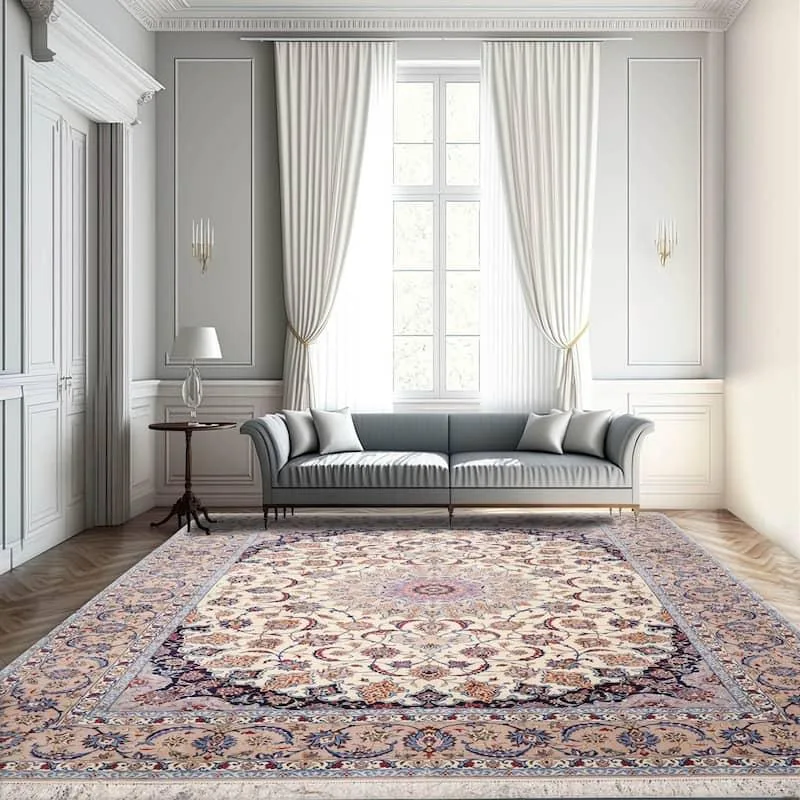
sfahan is one of Iran’s best-known cities for art and traditional crafts, and its carpets are a good example of the city’s long artistic tradition. Isfahan rugs are often recognised for their detailed floral patterns, balanced designs and careful workmanship. Many feature a central medallion, although you will also find rugs with all-over floral designs and other patterns.
Not every rug associated with Isfahan is made in exactly the same way. Materials, knot density, colours and overall quality can vary from one piece to another. If you are thinking about buying one, it helps to know which details to look at before making a decision.
Quick Answer: What Is an Isfahan Rug?
An Isfahan rug is a Persian carpet associated with the city of Isfahan in central Iran. Traditional examples are known for fine weaving, detailed floral patterns, central medallions and carefully designed borders. They may have a wool pile, often with silk details or a silk foundation in finer examples. Their quality and price depend on materials, craftsmanship, knot density, size, age and condition.
What Makes Isfahan Rugs Special?
Isfahan rugs are often admired for the amount of detail in their designs. Their patterns usually look carefully planned, with floral elements, curved branches and decorative borders arranged in a balanced way.
Some common features include:
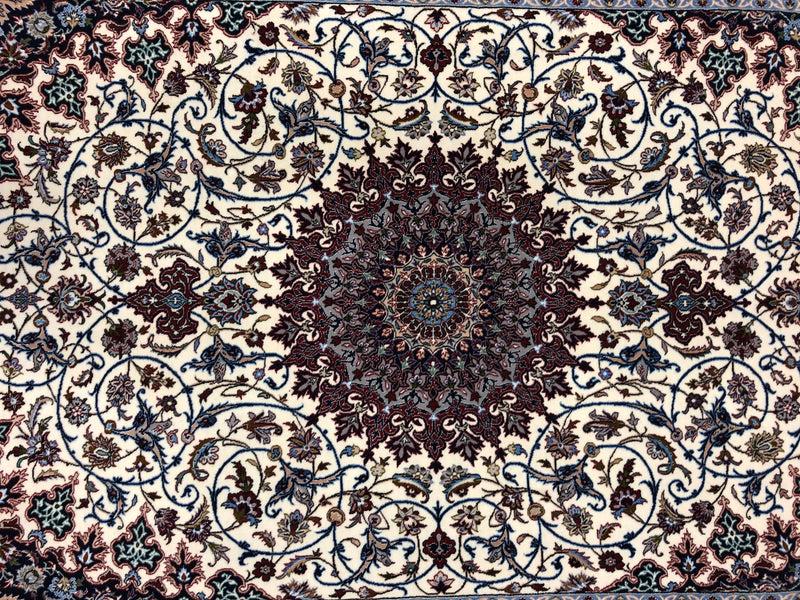
- Central medallions: Many designs have a prominent medallion in the middle, surrounded by floral patterns.
- Floral motifs: Flowers, leaves, vines and palmettes appear frequently.
- Detailed borders: Several decorative borders may frame the central field.
- Fine weaving: Many traditional Isfahan rugs have a relatively high knot density, allowing for detailed patterns.
- Rich but balanced colours: Blue, ivory, red, beige and other shades are used in different combinations.
These features are common, but they are not a checklist that every genuine Isfahan rug must meet. Designs and materials can differ between workshops and individual pieces.
A Brief History of Isfahan Carpets
Isfahan became an important centre of Persian art and architecture during the Safavid period, particularly under Shah Abbas I in the late sixteenth and early seventeenth centuries. The city developed a strong reputation for decorative arts, including carpet weaving.
Historical Persian carpets from this period often show the close relationship between carpet design, architecture, book illustration and other forms of art. Floral patterns, medallions and carefully arranged decorative elements were part of a wider visual tradition.
The carpets associated with Isfahan’s Safavid period are especially valued by museums and collectors. However, today’s Isfahan rugs include both traditional designs and more recent interpretations. An older design does not automatically mean that a rug itself is antique.
How to Recognise an Isfahan Rug
There is no single detail that can prove where a carpet was made. Still, several features can help you understand whether a rug is consistent with the Isfahan tradition.
Look at the Design
Many Isfahan rugs have a central medallion with floral patterns spreading across the field. Others use repeated floral arrangements without a dominant centre.
Look at how the motifs connect. In a well-designed rug, the pattern usually feels balanced rather than crowded. The border should also relate naturally to the central design.
Check the Weaving
Fine Isfahan rugs often have detailed patterns that are clearly visible on both the front and back. Turn the rug over and look at the knots and the definition of the design.
A high knot count can allow for greater detail, but it does not tell you everything about quality. Wool, construction, finishing and the condition of the rug matter too.
Examine the Materials
Many Isfahan rugs have a wool pile. Some finer pieces use silk in the foundation or as highlights in the design.
Be careful with descriptions such as “silk Isfahan rug”. Ask whether the pile is silk, whether only some details are silk, or whether silk is used in the foundation. These are different things and can affect the price considerably.
Materials Used in Isfahan Rugs
The materials used in a rug affect its feel, appearance, durability and value.
Wool
Wool is a common material for the pile of Persian rugs. Its quality can vary depending on the fibre, preparation and spinning process. A good wool pile should feel pleasant and have a natural appearance.
Silk
Silk may be used in the pile, foundation or selected design details. It adds shine and can help create very fine patterns. However, the presence of silk does not automatically make a rug better in every respect.
Cotton
Cotton is commonly used in the foundation of city-made Persian rugs. It provides a stable structure for the knots and helps the rug keep its shape.
When buying, ask the seller to explain exactly which materials have been used.
Isfahan Rug Quality: What Should You Check?
Two rugs with similar designs can differ significantly in quality and price. Before buying, take time to inspect the following points.
1. Knot density
A finer weave can make small details easier to create. However, knot density should be considered alongside the quality of the materials and the overall workmanship.
2. Pattern clarity
Check whether the design looks clear and consistent. Look at both sides of the rug, especially around the medallion and borders.
3. Colour
Look for an even appearance and check whether the colours are consistent across the rug. Some variation may be natural, particularly in older handmade pieces, but unexplained patches or signs of damage deserve attention.
4. Edges and fringes
Inspect the sides and ends. Loose edges, damaged fringes or poor repairs may affect the rug’s condition and value.
5. Overall condition
Check for worn areas, stains, holes, fading and previous repairs. A rug may look attractive from a distance but have problems that become clear on closer inspection.
For more general checks, see our guide to identifying an authentic Persian rug.
How Much Do Isfahan Rugs Cost?
There is no single price for an Isfahan rug. Prices can vary widely depending on the size, materials, knot density, age, condition and quality of the workmanship.
A small wool rug and a large, finely woven piece with silk details are not comparable products. Antique and collectible rugs can also have very different prices from recently made carpets.
When comparing prices, consider:
- The size of the rug
- Whether it is handmade
- The quality and type of wool
- Whether natural silk is used, and where
- Knot density and weaving quality
- The condition and any repairs
- Whether the rug has a documented history or provenance
If you are comparing several pieces, ask sellers for the same details. This makes it easier to understand why one rug costs more than another.
For a broader look at the factors that affect Persian carpet prices, read How Much Does a Persian Rug Cost?.
Isfahan Rugs Compared With Nain, Kashan and Tabriz Rugs
These cities all have well-known carpet traditions, but their rugs are not identical.
Isfahan and Nain: Nain rugs are often recognised by their light backgrounds and combinations of ivory, cream and blue. Isfahan rugs can also use light colours, but many are known for their elaborate floral compositions and balanced medallion designs. Read more about Nain rugs.
Isfahan and Kashan: Kashan rugs often have rich red and blue colours, floral designs and central medallions. There is some visual overlap with Isfahan carpets, so the construction and overall design are worth examining. See our guide to Kashan rugs.
Isfahan and Tabriz: Tabriz has a wide range of designs, including floral, medallion and pictorial patterns. The styles can be quite varied, so it is better to compare individual rugs than rely on a simple rule about which city uses which design. Learn more about Tabriz rugs.
Where to Buy Isfahan Rugs in Iran
If you are visiting Isfahan, you can look for Persian carpets in traditional shops and established carpet stores around the city. It is worth visiting more than one shop so you can compare designs, materials and prices.
Do not feel pressured to buy the first rug you see. Take photographs, ask questions and compare similar pieces before making a decision.
If you are not familiar with Persian carpets, a local guide may also help you explore the city’s markets and understand the local shopping environment. You can explore tours in Isfahan or find local tour guides in Isfahan through Pirsik.
A guide can help you navigate the city and communicate during your visit, but you should still assess the rug and its price independently.
Questions to Ask Before Buying
Before paying, ask the seller a few direct questions:
- Is this rug handmade?
- Where was it made?
- What materials are used in the pile and foundation?
- Is the silk natural silk or another fibre?
- What is the knot density?
- Is the rug new or old?
- Has it been repaired?
- Is there any documentation about its origin?
- Can you provide a written receipt with the rug’s details?
Clear answers are important. If a seller cannot explain the materials or origin, be careful about paying a premium based on those claims.
Do Isfahan Rugs Work in Modern Homes?
Yes. Although many Isfahan rugs have traditional floral patterns and detailed borders, they can work well in different interior styles.
A large rug with a central medallion can become the main feature of a living room. Smaller pieces can be used in bedrooms, studies or quieter areas of the home.
If your furniture and walls are simple, a detailed Isfahan rug can add colour and pattern. For a more subtle look, choose a design with softer colours and less contrast.
Before buying, measure the space and think about how much daily use the rug will receive. A delicate silk-pile rug may be better suited to a low-traffic area than a busy entrance or family room.
Is an Isfahan Rug Worth Buying?
An Isfahan rug can be a good choice if you appreciate fine patterns, detailed workmanship and traditional Persian design. However, the name alone should not determine your decision.
Look at the individual rug. Check its materials, construction, condition and price. A well-made rug that suits your home and budget is usually a better purchase than an expensive piece bought only because of its regional name.
Frequently Asked Questions About Isfahan Rugs
What are Isfahan rugs known for?
They are often known for fine weaving, detailed floral designs, central medallions and carefully arranged borders. Many traditional examples have balanced compositions and rich colours.
Are Isfahan rugs handmade?
Traditional Isfahan rugs are hand-knotted. However, you should confirm how an individual rug was made rather than relying only on its label.
Are Isfahan rugs made of silk?
Some contain silk, either in selected details or more extensively. Many have a wool pile and cotton foundation. Ask the seller which materials are used in each part of the rug.
Are Isfahan rugs expensive?
Some are expensive, particularly finely woven pieces made with high-quality materials. Size, condition, design and age also affect the price.
How can I tell if an Isfahan rug is genuine?
Look at the design and construction, inspect the back, and ask for information about its materials and place of production. No single visual feature can confirm its origin.
Where can I buy Isfahan rugs in Iran?
You can look for them in carpet shops in Isfahan and compare several sellers before buying. Ask about materials, condition and origin, and make sure the details are included in your receipt.
Final Thoughts
Isfahan rugs are worth looking at if you appreciate detailed patterns and traditional Persian design. Their floral compositions and careful weaving are part of a long artistic tradition, but the name alone should not decide whether a rug is right for you.
Compare the individual pieces, check their materials and condition, and ask clear questions about their origin. A good purchase is one that suits your taste and budget, with no uncertainty about what you are paying for.
Leave a Reply